Event 1
Protagonist's Arrest and Pretrial Detention
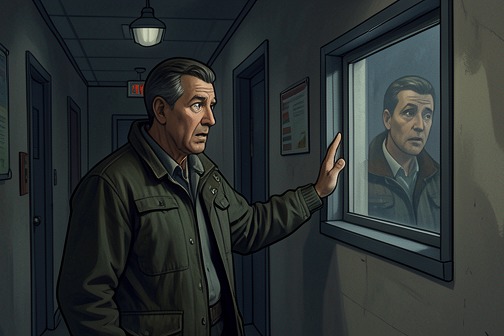
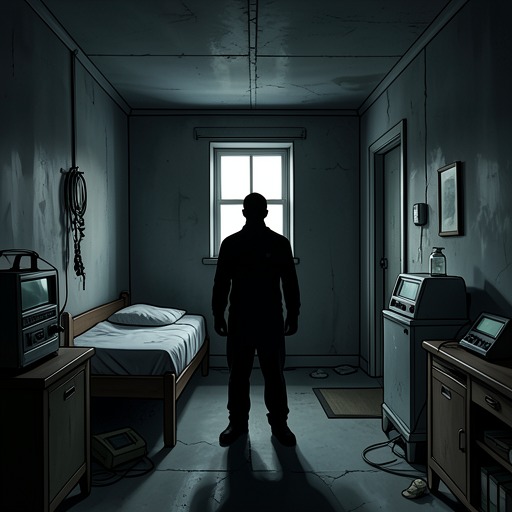
[Protagonist's Arrest and Pretrial Detention](entity:event-recall-event-765d32cf7631) moves the [Unnamed protagonist](entity:character-recall-character-unnamed-protagonist-bb1166336c76) from a locked remand cell into the first stages of court proceedings. The episode joins the physical routines of confinement to his growing suspicion of the legal process: he is held alone, struggles to orient himself in the dim cell, and enters court convinced that his defender may not act in his interests.
## Confinement in the Remand Cell
The account presents the Unnamed protagonist’s detention as an isolating, tightly bounded experience. In the dark corridor outside his cell, he studies his reflection in a small window and repeatedly reads labels above the dirty-linen baskets. The corridor is seven feet wide; the signs identify blue shirts, blue pants, blankets, bath towels, and hand towels. Rechecking them gives him a small task to pursue, though he does not actually verify that he has read them correctly.
Inside, he examines a blemish on his cheek in the mirror above the sink, then sits on the bunk. The night lighting seems to him as bright as daylight, even as he recognizes that the room is only dimly lit. Later, he directs smoke toward the cell’s vent and concludes that it does not draw air out. He regards the room as measuring two by four, resents the conditions, and imagines exposing the police department and jail system. He throws his cigarette into the commode and lies back on the bunk, turning his anger into an imagined campaign rather than an action shown to occur.
## First Court Appearance
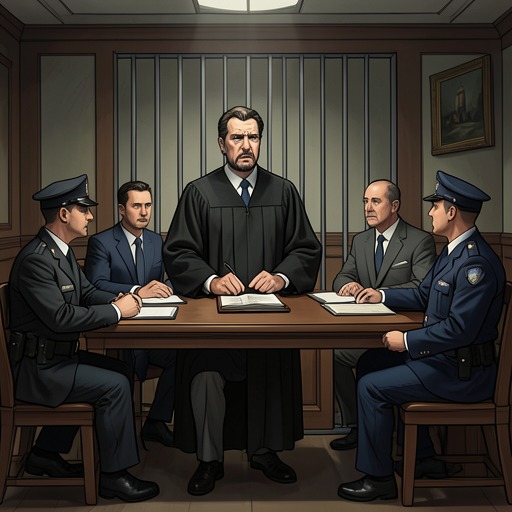
At the court proceeding, the Unnamed protagonist stands while the charges are read but registers much of the language as sound rather than meaning. Asked for his plea, he answers not guilty. His public defender gives him paper and a pencil and asks him to write down questions rather than interrupt testimony.
The instructions do not reassure him. He has only a vague sense of the defender beside him and does not know the man’s name; as the defender reviews papers and speaks with the district attorney, the Unnamed protagonist concludes that he has already been betrayed. When the first witness is called, he leans forward with the pencil ready, intending to note discrepancies himself and supply material that could undermine the prosecution’s case.
## Significance of the Episode
The episode sets the conditions of the Unnamed protagonist’s detention against his attempt to claim agency in court. In the cell, that effort takes the form of repeated observation, attention to small details, and fantasies of exposing the authorities. At the hearing, it becomes a plan to monitor testimony because he does not trust his own defender to do so. The shift from reading linen labels in isolation to watching witnesses in court links the confinement’s repetitive scrutiny with his self-appointed role in the proceedings.
Event 2
Protagonist's Preliminary Hearing
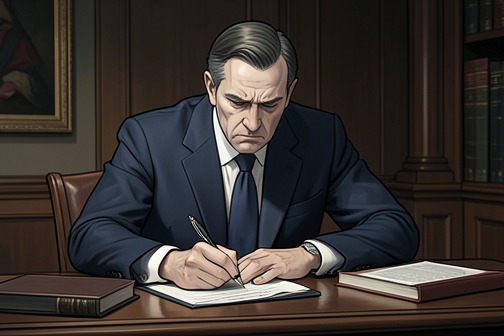
The [Unnamed protagonist](entity:character-recall-character-unnamed-protagonist-bb1166336c76)’s preliminary hearing is both a legal proceeding and a crisis of agency: while the [Courtroom](entity:location-recall-location-courtroom-2b80341d2488) moves through charges, testimony, stipulations, and motions, he struggles to understand what is happening and sees his own defender as another part of the machinery arrayed against him. The hearing ends without dismissal, but its deeper consequence is the conviction that procedure has shut him out rather than offered him a meaningful chance to answer the case.
## Charges and Disorientation
The hearing begins with the Unnamed protagonist standing as the charges are read. He recognizes a few words, but most of the formal language sounds to him like an alien sequence of terms. He hears the sounds without taking in their meaning; he knows that he is standing in a real Courtroom, not dreaming, but says little else is clear. Asked for his plea, he answers not guilty.
A public defender is beside him, but the relationship begins without familiarity or trust. The Unnamed protagonist has only been vaguely aware of the man’s presence. The defender tells him to sit, places paper and a pencil in front of him, and instructs him to write down questions rather than speak while witnesses are testifying, explaining that he cannot listen to both the Unnamed protagonist and the prosecutor at once. The protagonist accepts the paper and pencil silently. He does not know the defender’s name and has never seen him before; as the man turns to his papers and speaks with the prosecutor, the protagonist concludes that he has already been sold out.
## Testimony and Motions
The first witnesses are the arresting officers. The Unnamed protagonist initially tries to listen closely, pencil poised to record discrepancies that might help defeat the prosecution’s case. But as the testimony proceeds, he cannot find words for what is passing through his mind. His frustration grows, his posture sinks farther back in the chair, and the pencil eventually lies unused on the paper. His intention to monitor the evidence and supply his defender with useful points gives way to a sense that he cannot participate effectively in the hearing.
Much of the proceeding, as he experiences it, consists of procedural agreements and waivers. The attorneys stipulate to matters for the purposes of the preliminary hearing; the judge says that each is stipulated and enters it into the record. Items are waived and noted. When that sequence ends, the public defender asks the judge to dismiss the case on several grounds, citing cases and decisions. The prosecutor argues against dismissal and cites legal authorities in turn. A brief recess follows while the judge goes to chambers to consider the motions.
On returning, the judge speaks briefly with the attorneys, refers to their citations, and quotes some authorities of his own before denying the motion to dismiss. Questions and answers follow. The Unnamed protagonist sees his defender as allowing the proceedings to pass without doing anything for him, and experiences the hearing not as an argument in which he can be represented but as a succession of opportunities missed. The decision does not resolve his suspicion; it hardens it.
## The Hearing as Experienced
The account makes a sharp distinction between the formal shape of the hearing and the protagonist’s grasp of it. The Courtroom has recognizable stages—charges, a plea, witnesses, stipulated matters, legal motions, a recess, and a ruling—but those stages do not add up to a coherent explanation for him. He listens, yet cannot reliably translate what he hears into notes or an understanding of the case. His initial plan to identify contradictions therefore collapses before the procedural activity is over.
His sense of betrayal is similarly personal and immediate. The defender’s unfamiliarity and attention to papers become, in the protagonist’s interpretation, evidence that the man has already abandoned him. The record does not establish that the defender failed to make legal arguments: he does request dismissal and cites authorities. The conflict lies in the gulf between that formal act and what the Unnamed protagonist believes he needed—an active advocate who would notice the discrepancies he expected to find and give him a role in the defense. His judgment of the hearing is shaped by this mismatch as much as by the judge’s ruling.
## Return to the Cell and Aftermath
After the judge denies dismissal and the remaining questions end, the Unnamed protagonist is led out of the Courtroom and eventually back to his cell in [The prison](entity:location-recall-location-the-prison-9745412da591). He cannot say how long he sat in court, though other detainees later ask why he was there so long. Looking back, he reconstructs a day that began when a guard woke him at about 5:30 and ended with his return after 7:30, which he reckons as fourteen hours. The journey includes successive holding areas, changes of clothing, handcuffing to a chain, a bus ride to the courthouse, the Courtroom, and the return trip through more holding tanks. At the time, the waiting seems endless; in recollection, the entire day can be reviewed in minutes.
That compressed and distorted sense of time becomes part of the hearing’s meaning for him. He compares the proceedings to a ritual or a perpetual-motion machine: stipulations, waivers, questions, and answers keep the process moving, while he feels that no one knows or cares what the ritual is for. He imagines that he should have interrupted it, pushed his defender aside, and taken over. This is not something he does in court; it is a frustrated counterfactual that gives his helplessness a fantasy of control. He tells himself that this was only a preliminary hearing and that he will act differently when the case matters more, treating the next stage as an opportunity to defeat the rules he believes have constrained him.
The hearing also sits within the Unnamed protagonist’s broader account of law as a tool of police power. He argues that obscure and archaic laws make it possible to harass ordinary people, and that a vindictive officer can use authority to retaliate over minor conduct. Later, he generalizes his experience into a charge that the courts railroad defendants, contrasting severe consequences for petty theft with the lawyers and leniency he associates with wealthy offenders. These claims are his perspective, not findings established by the hearing itself. Their connection to the event is the way the denied motion and his perceived exclusion from his own defense become, for him, evidence of a larger system that he believes is designed to keep people like him from winning.
Event 3
Arrest and Detention in Providence During Adolescence
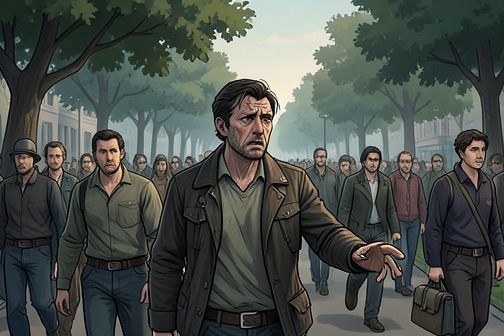
The [Unnamed protagonist](entity:character-recall-character-unnamed-protagonist-bb1166336c76)’s adolescent arrest and detention in [Providence](entity:location-recall-location-providence-f28903edfd18) is a remembered episode in which an ordinary shore leave becomes a confrontation with police authority. At fifteen, after running away from home again and working on an oil barge, he is taken to a station with Tom, accused of sexual misconduct involving a girl, and threatened with twenty years in prison. The two are released the following afternoon, but the episode’s emotional center remains the gap between that threat and the protagonist’s inability, at his age, to imagine what such a sentence would mean.
## Background and Encounter
The episode begins with the Unnamed protagonist’s repeated flight from home. He is fifteen and has taken work on an oil barge during wartime, when employers ask few questions so long as a worker can do the job. The vessel docks in Providence, where he and Tom, another deckhand, have the night off. Their presence in town is therefore temporary: they have to find their way back to the barge after spending the evening ashore.
The two walk around, go to a large movie house, and then continue through a park. The account does not identify the film, and the protagonist never learns the girl’s name. Tom takes the lead in approaching her and suggests going behind a small building. The encounter is described as a confused adolescent episode, with the boys unsure of what to do and unwilling to go further. When they set off toward the bus stop, they are uncertain of the route, and the girl walks with them to show the way. That practical decision places all three together on a dark, narrow street when a car pulls alongside them.
## Arrest and Interrogation
Two men get out, seize the boys, and order them into the car. The protagonist trembles and tries to ask what is happening but cannot speak. The men identify themselves as police officers and say they want to check on the girl because they think she may have run away. The stated concern is thus framed as a check on her welfare; the boys are nevertheless taken to the station in silence, without any account of what will happen there.
At the station, the girl is taken to a separate room, while the boys’ pockets are emptied and their belongings placed in envelopes. The separation is followed by questioning. An officer tells the protagonist that Tom has already given an account and accuses the two of sexual misconduct involving the girl. Another detective says he will personally see that the boys receive twenty years. The accusation and the threatened sentence arrive as assertions of authority, not as a process the fifteen-year-old can understand or answer with confidence. The scene shifts the encounter from uncertain adolescent conduct to the much larger danger of criminal punishment.
## Detention and Release
After the threat, the protagonist sits on a steel slab serving as a bunk. Through the bars, he can see the faint glow of a street lamp at a window across from the cell. He stares for a long time, thinking of what his mother would say and trying to grasp the meaning of twenty years in prison. Though he feels he has been alive a very long time, he is only fifteen; the sentence seems like an eternity, too vast for him to conceive. His tears fall without his brushing them away. The account lingers on this mismatch between a severe adult threat and a child’s limited ability to imagine the future it implies.
Sometime the next afternoon, a guard calls him out. In the office, Tom and two detectives are present. The protagonist is told that a doctor has examined the girl and that the boys will be released this time. The detective adds a threat of physical punishment if either returns. The examination and release end the immediate detention, but the warning means that departure is not presented as a simple vindication or reconciliation; police authority remains in the room even as the boys are allowed to leave. A further dismissal sends them away with their belongings and receipts to sign.
## Aftermath and Narrative Significance
The boys leave as quickly as possible and return to the barge. Tom jokes about what happened on the way back, while the Unnamed protagonist can think only that he is going home. The contrast marks their different responses without establishing what Tom’s joking means: the remembered account gives the protagonist’s fear and urgent relief more weight than any shared interpretation of the night. The episode ends not with a resolution of the accusation but with escape from the station and the prospect of home.
The girl remains unnamed to the protagonist, and the passage offers no account of her later circumstances. That absence sets a limit on what the episode can claim about her while emphasizing how narrowly the boy experiences the event: the night is remembered through his own arrest, the threatened sentence, and release. Providence becomes the setting for a sudden collision between his precarious life away from home and the power of the police to detain and intimidate him. The abrupt movement from a movie and a walk to a cell, then from a sentence he cannot imagine to a hurried return to the barge, gives the recollection its defining reversal: the threat is immense, the detention brief, and the boy’s relief immediate but not expansive.
Event 4
Police Break the Protagonist's Hand
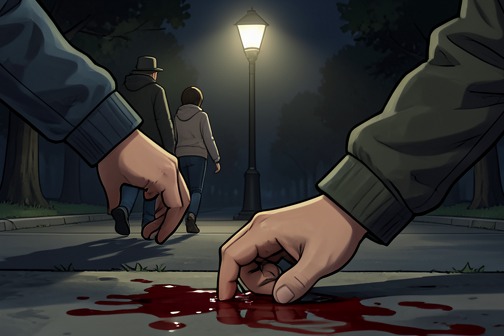
The [Police Break the Protagonist's Hand](entity:event-recall-event-aa4fb6d1d671) is a formative episode of police violence remembered by the [Unnamed protagonist](entity:character-recall-character-unnamed-protagonist-bb1166336c76) during his imprisonment. A police officer strikes him across the hand while he is reaching for dice in a park; the pain is delayed, the injury is hidden from his parents, and an X-ray the next morning reveals three clean breaks. The memory returns not as a resolved account of justice, but as a source of grievance that feeds the protagonist's fantasies of revenge and his broader distrust of police power.
## Circumstances of the Assault
The Unnamed protagonist is twelve or thirteen, playing dice with two friends beneath a light in a park on a cool evening. The boys are absorbed in the game and in keeping their hands warm. Two cents lie on the ground, and he is reaching for them when someone calls out that a police officer is there. As he bends to grab the money, an officer emerges from bushes behind him and strikes his reaching hand with a club.
The officer does not pursue the boys, and the protagonist never learns what he looks like. He runs without feeling the injury at first. A block away, he meets his friends; they walk the remaining few blocks home together. They ask about his hand, and he tells them it is all right, although it is beginning to burn. The sudden blow and the officer's disappearance leave the episode without an identified assailant or an immediate confrontation: the protagonist carries the injury away, but not the officer's face.
## Injury and Concealment
At home, the warmth makes the pain worse. The protagonist is afraid to tell his parents what happened because he expects them to ask why he was hit, and he is also afraid to admit what he and his friends had been doing. In the middle of the night, the pain becomes acute; he moans in his sleep, waking his mother. He tells her that he fell while playing a game and hurt his hand, substituting a safer explanation for the assault.
The next morning, his mother takes him to a hospital, where an X-ray shows three sharply broken bones. The breaks are so clean that they show no splintering, despite the force of the blow. The injury does not need to be set or placed in a cast: a small roll of gauze is put in his palm and the hand is wrapped. The medical simplicity of that treatment contrasts with the violence that produced the injury. The episode establishes both a concrete bodily consequence and the protagonist's early decision to conceal its cause from his family.
## The Memory in Prison
The assault reappears in the protagonist's prison thoughts as he paces repeatedly between the wall and the door, counting his steps and trying to keep them identical. The rigid counting turns into a stream of anger. He imagines fixing matters when he gets out, getting the officer who broke his hand removed from the force, and eventually taking revenge with the officer's own club. He also directs his rage at two other men, but the remembered strike itself was delivered by one officer, whose identity remains unknown to him.
This imagined retaliation is not an account of what happened after the childhood injury; it is what imprisonment makes the memory do in the present. The protagonist moves from a precise recollection of the club hitting his hand to a future-tense promise of punishment. The memory offers an object for his rage, but no verified route to identifying or holding the assailant accountable. The distinction between the known event and the imagined reckoning remains important: the assault is recalled as fact, while revenge is still a fantasy.
## Police Power and Recurring Resentment
Elsewhere, the protagonist develops a sweeping argument that obscure laws give police tools to harass citizens, and that officers may use authority to avenge real or imagined grievances. The childhood assault supplies a personal history for that conviction: a boy reaching for two cents is struck by an officer, then goes home hiding why his hand hurts. The memory supports the protagonist's sense that ordinary vulnerability can meet force without explanation, although his general claims about police and law remain his own assertions rather than findings established by this incident.
The injury also resurfaces when he thinks of a separate episode involving a woman shot by a child. He recalls the police searching the neighborhood and handling the boy's toy shotgun and cap pistol, then turns back to the officer who broke his hand and wishes he had taken the man's club. That association places the childhood blow within a wider, unsettled store of anger about policing; it does not establish a connection between the two events. In a later prison outburst, the protagonist likewise describes the justice system as rigged against people without money and resents the unequal treatment of poor defendants. Together, these recollections show how the hand injury becomes more than an isolated childhood wound in his telling: it is a recurring point of reference for his distrust of authority, his sense of being wronged, and his imagined payback. The account supplies no later identification of the officer, investigation, or remedy.
Event 5
Protagonist's Imagined Campaign Exposing Police Corruption and Spurring a State Legislature Investigation

The [Unnamed protagonist](entity:character-recall-character-unnamed-protagonist-bb1166336c76)’s imagined campaign to expose police corruption and provoke a State Legislature investigation transforms the helplessness of confinement into a public crusade. Its imagined victories are carefully assembled from his own grievances: he supplies the injury and testimony, while [Donald Preston](entity:character-recall-character-donald-preston-7d2d952ebe42) and [Stacey Lowry](entity:character-recall-character-stacey-lowry-3962c7d4dfb3) provide the press, documentation, and political machinery. The campaign’s apparent progress is therefore both a fantasy of institutional redress and a portrait of how thoroughly he wants to reverse the powerlessness he associates with the justice system.
## Causes and Premise
The vision grows from a letter the Unnamed protagonist has sent about what he describes as a Police State. He argues that the State’s police presence makes citizens feel watched wherever they go, and that obscure, antiquated laws give officers opportunities to harass people. Even an ordinary act such as spitting on a sidewalk, he contends, could be used against someone; minor conduct and a police officer’s personal grievance can become occasions for punishment. These are the protagonist’s accusations, not an independent account verifying each charge, and the fantasy makes them the starting point for a campaign rather than leaving them as private complaint.
Donald Preston and Stacey Lowry tell him that simply publishing his letter would accomplish little. Outrage, they warn, would fade as readers returned to everyday responsibilities unless someone pursued the issue vigorously. They say they have been looking for a person with his experience and propose using it as the campaign’s springboard. The distinction between a personal grievance and a public cause is central to the plan: his case is meant to reveal a wider pattern, including harms that could affect citizens’ children and future generations.
The proposed strategy combines public speaking, newspaper coverage, and the recovery of documentary material. Stacey Lowry is to address professional, civic, and other willing groups, while Donald Preston continues a daily series in the paper. They will search old files for statements, letters, depositions, photographs, and even rumors that could attract public attention and press the legislature to investigate. The plan openly allows for any available means, however devious, in pursuit of that end. When the Unnamed protagonist doubts that politicians will challenge a system they helped create, Donald Preston answers that officeholders are responsive to constituents because they want to remain in office.
## From Complaint to Public Campaign
In the imagined sequence, the campaign gathers momentum after the Unnamed protagonist’s trial. He describes his handling of the defense attorney as the real beginning of his confidence: days on the witness stand without faltering become, in his account, concrete proof that he can manage any public challenge. Interviews with reporters and television then give him additional poise. What began as apprehension about the campaign gives way to certainty that he can face whatever follows.
A [Sunday](entity:time-recall-time-sunday-073632221971)-supplement interview introduces him to a broad readership, accompanied by photographs of jails and detention homes. The following week, a series of illustrated articles emphasizes that people held in these conditions have been accused, not convicted, and remain presumed innocent under the law. The account gives particular weight to juveniles sleeping on floors and suffering from malnutrition. Some, it says, have not been accused of any crime at all; they are in custody because sick or unable parents cannot care for them and they have nowhere else to live. In the protagonist’s imagined campaign, these details turn an abstract charge of official abuse into visible human consequences.
The response exceeds expectations: reading and acknowledging letters becomes a full-time task. Coverage extends throughout the country, and the State Legislature is depicted as pressing the campaigners to testify. Donald Preston and Stacey Lowry bring attaché cases filled with photographs and documents, but the Unnamed protagonist regards himself as the campaign’s nucleus. To him, records and statistics supply facts, while his personal testimony makes those facts intelligible and emotionally real to the public. His presence is not merely another item of evidence; it is what gives the evidence significance.
## The Hearing as Reversal
At the Capitol Building, reporters, photographers, and television crews are already waiting. The Unnamed protagonist expects questions before he even enters, but imagines answering calmly and continuing to tell the truth about the authority he says has abused him. He recognizes familiar reporters, responds to the press, radio, and television, and then enters flanked by Donald Preston and Stacey Lowry. The passage dwells on the contrast with his earlier experience in court: marble corridors, high ceilings, and heavy doors recall the courthouse where he felt vulnerable and ignored, but now he enters as a public figure whose presence draws attention.
The old anger does not disappear. Remembering the earlier courtroom brings back his rage at the police officers he believes lied and at the public defender he believes failed him. He imagines punishing those officers, then distinguishes the present scene from that earlier helplessness: he now feels that he is someone who must be reckoned with. Having the two officers dismissed from the force would not be enough, he thinks; the campaign must continue until the entire system is exposed. His imagined resolve to keep fighting even if Donald Preston and Stacey Lowry stop gives the fantasy an escalating, uncompromising edge.
Inside the hearing room, he sees a crowded chamber, microphones, press tables, and the people assembled to watch him. He believes that the audience, and people beyond the room, sympathize with what he is trying to do. Even a nod, he imagines, could become news. The committee chair opens the proceedings by presenting the inquiry as necessary and urgent, rejecting the suggestion that it is either a whitewash or a partisan indictment, and promising a search for truth. The Unnamed protagonist nods alongside his allies as the chair acknowledges their cooperation.
Stacey Lowry then reads a prepared statement that functions as the campaign’s manifesto. It gives humane reasons for the effort, previews the evidence, and thanks the committee for responding quickly to the request to present the investigation’s findings. Stacey Lowry follows it by praising the Unnamed protagonist as the campaign’s most important member. The imagined hearing thus places his personal story within an organized political effort while also making him its honored centerpiece.
## Fantasy, Justice, and Self-Image
The campaign’s triumphant conclusion is explicitly part of the protagonist’s inward vision. As Stacey Lowry’s tribute continues, he lowers his eyes modestly and lets the scene drift rather than trying to preserve its full clarity. He imagines people photographing him and shaking his hand, committee members speaking with him, and the officers who had harmed him asking for help and forgiveness. The fantasy reaches a reversal unavailable in the earlier courtroom: those who once held power over him now depend on him. He then drifts into sleep in his cell, the imagined public recognition giving way to waking confinement.
The scene draws force from the gulf between formal legal ideals and the protagonist’s experience of legal process. When charges were read at his earlier appearance, much of the language sounded unintelligible; he pleaded not guilty, accepted paper and pencil from an unfamiliar public defender, and quickly concluded that the attorney had already abandoned him. Later, he generalizes his distrust into the claim that poor defendants are punished harshly while wealthy offenders can secure skilled lawyers. Those resentments explain why the campaign fantasy treats testimony, publicity, and legislative attention as instruments of justice—and why the prospect of being listened to matters as much as the promised investigation.
The imagined campaign does not establish that the investigation or its victories occur outside the vision. Instead, it reveals how the Unnamed protagonist recasts injury into a narrative of public vindication: his testimony turns cold evidence into lived proof, the hearing places him at the center of the room, and the men he resents are reduced to asking his pardon. The same vision that gives him confidence also preserves his rage and presents the pursuit as something he will never abandon. Its political hope and its personal appetite for reversal remain intertwined.
Event 6
Mrs. Haagstromm Attacked by Two Police Officers
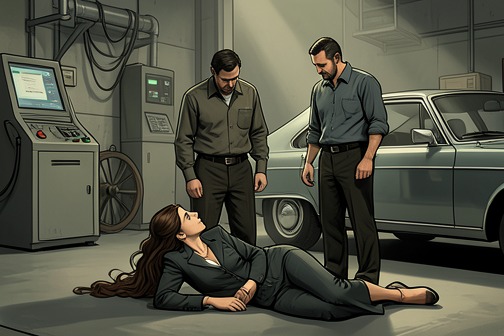
[Mrs. Haagstromm Attacked by Two Police Officers](entity:event-recall-event-b8da7a76a3e1) is an assault recounted as part of the [Unnamed protagonist](entity:character-recall-character-unnamed-protagonist-bb1166336c76)’s imagined campaign against police abuse. [Harry](entity:character-recall-character-harry-51d33e4b3663) and Fred use a purported vehicle check to take Mrs. Haagstromm away from the road, then assault her in a secluded area. The consequences extend far beyond that night: she suffers life-changing injuries, while her repeated identification of the officers does not lead to admissible evidence or their removal from the force. The account’s central reversal is stark: the officers invoke public authority to control her, and that same authority remains intact afterward.
## Background and Pretext
Mrs. Haagstromm is introduced as a young woman whose life had been stable and uneventful. She came from a good family, completed college, married, and had a daughter; her family was described as happy before the night of April 2. Her husband was away on business, and she had left her daughter with her mother while visiting friends. She was driving to collect the child when the two officers stopped her. These ordinary details establish the practical circumstances of her vulnerability without making the attack seem inevitable: she was on a familiar family errand, expecting to continue home.
Harry and Fred claimed that her car matched the description of a stolen vehicle and said that it needed to be checked. Their explanation made the stop appear to be routine police work. One officer drove Mrs. Haagstromm’s car while the other followed in the patrol car, carrying her away from the route she had intended to take. When Harry returned to the car, he described a discrepancy and said they would have to go to the station to resolve it. Mrs. Haagstromm objected that she needed to pick up her daughter and said she did not understand what was happening; Harry reassured her that it would not take long. The false promise of a brief, ordinary procedure is the hinge on which the encounter turns.
## Seizure and Assault
Instead of taking Mrs. Haagstromm to a station, the officers drove to a deserted, wooded area. There they restrained and gagged her and assaulted her. The account describes the attack at a high level, emphasizing that it was repeated and coercive rather than supplying further detail. Harry and Fred acted together: one held her while the other participated in the assault, and they used their position and control of the situation to prevent her from leaving or seeking help.
Their conduct continued after the assault. The account says they left Mrs. Haagstromm in her car, without clothing, and that she was not found until late the following morning. They also threatened her with arrest and with the humiliation of her daughter learning about the assault if she reported them. That threat sought to make the victim bear the consequences of disclosure while shielding the officers from scrutiny. Their departure therefore did not end the coercion; it extended it into the question of whether she could safely tell anyone what had happened.
## Medical and Personal Aftermath
Mrs. Haagstromm was admitted to [General Hospital](entity:location-recall-location-general-hospital-19f101323aca) near death from shock. Her injuries required intensive treatment over a period of months. The account states that damage to her wrists and ankles led to infection and that her right foot eventually had to be amputated; her remaining ankle and wrists took months to heal. These outcomes establish the lasting physical cost of the assault without reducing her experience to a single moment of violence.
The loss and prolonged treatment also sharply contradict the officers’ promise that the detour would take only a short time. What they presented as a minor discrepancy became an event that altered Mrs. Haagstromm’s health and family life. The narrative had described her as a mother returning to collect her daughter; after the assault, she instead faced a long recovery and permanent bodily change. It records those consequences while offering little account of her later daily life, leaving the scale of the harm clear but her subsequent experience largely unelaborated.
## Identification and Institutional Aftermath
The police commissioner of the city was informed, and doctors were given photographs of officers who had been on duty in the area that night. During a lucid interval, Mrs. Haagstromm was shown a set containing photographs of Harry and Fred. She reacted strongly when she saw them. On later occasions, the same two photographs were placed among others, and her response recurred when she reached them. In the account, the repeated identification gives the accusation a specific basis; it is not presented as a single uncertain recognition.
Yet identification did not become a case that could be prosecuted. The account says that those who knew of the matter had no doubt that the two men were the assailants, but that no admissible evidence was available. Harry and Fred continued serving as officers. The gap between recognition and legal action is the event’s decisive institutional consequence: Mrs. Haagstromm’s suffering is documented, and the suspected perpetrators are identified, but the evidentiary barrier leaves them in their positions.
The account’s later movement into public testimony belongs to the Unnamed protagonist’s imagined campaign exposing police corruption. Its shift from the immediate encounter to Mrs. Haagstromm’s background, medical consequences, and identification process makes the case more than a private horror story: it arranges the facts as an argument about police power, the difficulty of proving abuse, and the protection that can follow when proof fails. The officers’ continued service supplies the unresolved ending. Mrs. Haagstromm’s identification is heard, but it does not, in this account, bring accountability.
Event 7
Testimony Before the U.S. Senate Investigating Committee
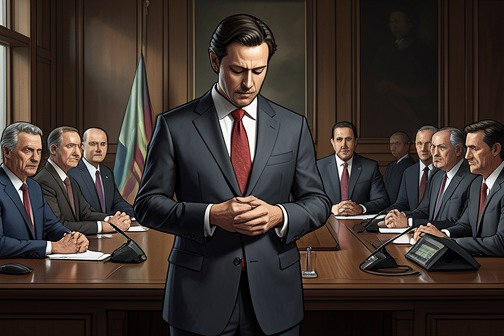
[Testimony Before the U.S. Senate Investigating Committee](entity:event-recall-event-bbc8cd3ce6cd) is an imagined hearing in which the [Unnamed protagonist](entity:character-recall-character-unnamed-protagonist-bb1166336c76) recasts his grievance against the police as a public campaign against injustice. His address moves from a sweeping warning about state power to the case of Mrs. Haagstromm, whose alleged assault and devastating aftermath expose the gulf between identifying perpetrators and securing accountability. The scene’s importance lies both in the testimony’s moral argument and in its unstable frame: the public vindication it promises is taking shape in the protagonist’s imagination while he remains imprisoned.
## Setting and Narrative Frame
The testimony opens as a formal public occasion. The protagonist pauses, looks down at his hands and then toward the senators seated behind a long table, conscious of the microphones, cameras, lights, and watching eyes. He imagines that the hearing will carry his words across the country and perhaps the world. Although he recognizes the danger he associates with speaking publicly, he presents himself as calm because he believes the cause demands action.
That composed appearance belongs to a vision rather than a documented hearing. The narrative places the speech within the protagonist’s imprisonment: he stretches out on his cell bed and listens to an imagined committee proceeding. The scene therefore gives his appeal the scale and ceremony of national testimony without showing that such a hearing has occurred in the external events of the story. Its imagined public platform stands in contrast to his actual confinement, where he has little control over his immediate circumstances.
The address also extends an argument already forming in his writing. He describes a society under a pervasive police presence and contends that obscure, outdated laws give officers opportunities to harass ordinary people. In the imagined testimony, this broad indictment becomes a case for exposing particular abuses: injustice, he argues, cannot be dismissed as minor merely because it affects one person or occurs far from public view.
## The Appeal to Public Responsibility
The protagonist casts himself as speaking not only for himself but for people who have suffered before him, people suffering in the present, and those who might otherwise face similar treatment in the future. He urges the imagined senators to regard injustice as a shared civic danger rather than an isolated misfortune. The argument builds from individual vulnerability to national consequence: an abuse left hidden can spread, while public exposure is necessary to prevent corruption from taking deeper root.
His language gives the testimony the form of a moral appeal. He acknowledges his own smallness as an individual but claims that truth supplies a source of strength greater than personal stature. The hearing thus becomes a stage on which a prisoner imagines his accusation acquiring institutional authority. His personal conflict with law enforcement is recast as a test of whether the country will defend the people most exposed to official power.
The argument is also shaped by a tension between evidence and conviction. The protagonist speaks with certainty about the danger he faces and the justice of his cause, but the narrative has already shown his intense anger and his fantasies of punishing police officers. The imagined speech gives that anger a public, reformist form. It presents the possibility that his desire for redress might be heard as a demand for truth, without erasing the retaliatory force that runs through his other prison fantasies.
## Mrs. Haagstromm’s Case
As the address’s central example, Mrs. Haagstromm’s case gives the abstract charge of police abuse a specific human history. In the account presented to the committee, she is a young wife and mother with a college education and no prior trouble with the law. Her husband is away on business when she leaves her daughter with her mother and later drives to collect the child. Two police officers stop her, claiming that her car resembles one reported stolen. One drives her car while the other follows in a patrol car; instead of taking her to a police station, they bring her to a deserted, wooded area and assault her.
The testimony describes consequences without treating the attack as an isolated incident. Mrs. Haagstromm is found the following morning and admitted to [General Hospital](entity:location-recall-location-general-hospital-19f101323aca) in critical condition. Her injuries include damage severe enough that her right foot must be amputated, while her other ankle and wrists take months to heal. The account also says the officers beat and burned her. These details establish the lasting physical harm the speech attributes to their actions, while its larger emphasis falls on the life those actions leave behind: a mother and wife who had been living independently is described as unable to care for herself after the assault.
Her psychological condition becomes the measure of the prolonged aftermath. The imagined testimony says she enters a state mental institution at twenty-three and is twenty-four when the protagonist speaks. Nearly a year into her stay, she remains too distressed to talk without heavy sedation. The account reports that she has received more than one hundred shock treatments, with improvement lasting only weeks before her condition worsens again and restraint and further treatment become necessary. Doctors, as relayed in the speech, expect her to remain in a locked ward and see no prospect of recovery.
The testimony also conveys how little of the night’s events could initially be recovered from her. Hospital staff reportedly heard her repeatedly ask to be allowed to die while she was heavily sedated. Doctors pieced together the account over time from lucid moments and hypnosis. The protagonist acknowledges that parts of her story are incomplete and confused, but insists that enough has been established to identify what happened. This combination of traumatic silence and confident public narration is central to the scene: the woman whose experience is being invoked cannot herself give the committee a stable account.
## Identification and the Failure of Accountability
The testimony describes a further attempt to identify the officers. The police commissioner supplies doctors with photographs of officers who were on duty in the area that night. During lucid intervals, Mrs. Haagstromm is shown the photographs; when she encounters two of them, she screams, covers her eyes, and refuses them. The account says the same response occurs when the pictures appear among other photographs on later occasions. The protagonist presents this repeated reaction as establishing the men’s identities beyond doubt.
Yet the speech says the officers remain at work because there is no admissible evidence. This is the case’s decisive institutional reversal: a woman’s repeated response to the photographs is treated by the protagonist as certain recognition, but, in his account, it does not meet the threshold needed to hold the men legally responsible. Later imagined questioning makes the evidentiary conflict more pointed. One officer denies knowing Mrs. Haagstromm, and the questioning challenges that denial by referring to identification through a name tag and to laboratory tests. Those exchanges belong to the same imagined campaign; they intensify the protagonist’s case but do not establish an external trial or verdict.
The narrative links the two officers in Mrs. Haagstromm’s account to [Harry](entity:character-recall-character-harry-51d33e4b3663) and Fred, whom an earlier scene depicts using a false vehicle-registration pretext to take her away. That connection gives the testimony continuity with the book’s prior account of the assault, while its committee setting changes the mode of presentation: what was previously rendered as an encounter is now organized as evidence offered before an imagined national audience.
## Response and Significance
After the protagonist’s account, the imagined committee chairman thanks the witnesses for presenting evidence of misuse and abuse of authority. He singles out the protagonist for speaking despite threats to his life and invokes truth as necessary to the country’s freedom. The response supplies the public recognition absent from the protagonist’s real confinement. The hearing appears to endorse his testimony and to place Congress beside him in a shared stand against injustice.
That resolution remains part of the vision. The committee’s gratitude does not release the protagonist, establish that investigators have acted, or demonstrate that the officers have been prosecuted. Instead, it shows the outcome he imagines his testimony should produce: his account is heard, its seriousness acknowledged, and the country’s institutions are called to act. The scene’s formal confidence therefore coexists with uncertainty about the boundary between an actual event and the protagonist’s desired public vindication.
As an episode, the testimony gathers the book’s concerns about police power, legal evidence, and the unequal ability to make suffering credible. Mrs. Haagstromm’s case supplies a concrete example of extreme harm and an apparent identification that, as the protagonist tells it, fails to secure accountability. His imagined address transforms those circumstances into an appeal to collective responsibility. But the frame also complicates that transformation: the same prisoner who condemns official violence repeatedly imagines violent retaliation, and his certainty about the hearing belongs to a mind moving between confinement and elaborate visions of justice.
Event 8
Cross-Examination of Police Testimony in the Jewelry Store Case
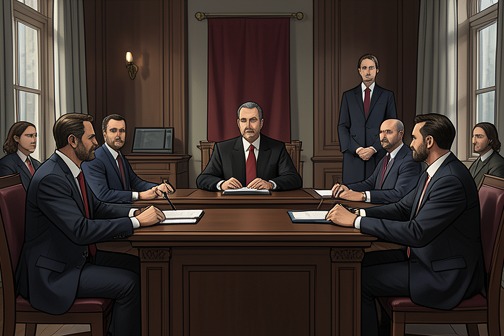
The [Cross-Examination of Police Testimony in the Jewelry Store Case](entity:event-recall-event-50f1cf47ce9c) is a courtroom confrontation in which the [Unnamed protagonist](entity:character-recall-character-unnamed-protagonist-bb1166336c76) tries to dismantle a police account of a suspicious figure outside [Kramers Jewelry Store](entity:location-recall-location-kramers-jewelry-stor-5388768e5189). Rather than treating the officers’ testimony as settled fact, he presses on how they could have made and maintained their identification under the conditions they describe. The questioning then reaches beyond the jewelry-store allegation: the protagonist connects one witness to Mrs. Haagstromm’s assault, and the witness’s composure gives way. The scene makes cross-examination both a legal tactic and the protagonist’s imagined means of forcing official violence into public view.
## Setting and Narrative Frame
The scene is presented as courtroom questioning, but it belongs to the Unnamed protagonist’s imagined campaign against police corruption rather than standing as an independently verified account of a completed trial. Elsewhere in the narrative, he is shown at a hearing, disoriented as charges are read and distrustful of the defense counsel seated beside him. He answers not guilty, then concentrates on listening for discrepancies that he believes his attorney might miss. The imagined cross-examination reverses that position: instead of sitting silently while legal professionals control the proceeding, he takes charge of the questioning and directs attention to gaps in the officers’ account.
The imagined courtroom is part of a larger effort to expose what the protagonist calls a police state. In his account, old and minor laws give officers opportunities to harass ordinary people, while official authority can be used to settle real or imagined grievances. His expansive claims are the protagonist’s own, not neutral findings established by the cross-examination. Within that frame, however, the jewelry-store testimony supplies a specific target: a police narrative whose details, he argues, do not fit together.
## Testing the Officers’ Account
The questioning begins with a witness’s account of driving north on Hill Street and seeing a person in the doorway of Kramers Jewelry Store, on the north side of the 2200 block of Hill Avenue. The witness confirms the location. The protagonist then focuses on the conditions under which the officer claims to have noticed and identified the person. If the officer was monitoring speed, traffic lights, and vehicles in the street, the protagonist asks, how could he also pick out a figure hundreds of feet away in a dark doorway, regard the figure as suspicious, and study him closely enough to identify him positively? The witness rejects the implication that these demands conflict, but does not resolve the underlying question to the protagonist’s satisfaction.
The challenge grows more elaborate when the protagonist revisits the officer’s claimed view during the car’s movement across an intersection. He asks the court to accept that the officer could keep the defendant in sight despite bright light in his eyes, shadows around the defendant, and parked cars obstructing the view—and could also know that no other person was present or had fled. The same officer, the protagonist argues, supposedly recognized a hardened criminal in darkness yet stood under a streetlight and requested identification without drawing a weapon or searching the man. The passage piles one asserted certainty on another, making the officer’s calm approach appear difficult to reconcile with the danger the officer supposedly perceived.
A second contradiction concerns the arrest itself. The protagonist contrasts the allegation that the defendant had tried to run over two trained officers with the claim that, after a light tap with a gun, he became submissive and walked to the patrol car. He proposes a different explanation: that the man was already incapacitated after being beaten, dragged, and thrown into the vehicle. The witness confirms that the defendant was handcuffed after being put on the floor of the back seat. The questioning thus shifts from what the officers could see to what happened between the alleged encounter and the arrest, using the sequence of restraint to challenge the official description of the defendant’s behavior.
## The Accusation Concerning Mrs. Haagstromm
The cross-examination takes a more consequential turn when the protagonist brings Mrs. Haagstromm into the questioning. The witness initially denies having spoken to [Harry](entity:character-recall-character-harry-51d33e4b3663) about perfume in the back of the car or having mentioned Mrs. Haagstromm. Later, the protagonist returns to the subject, asking whether the woman smelled like a rose when she was put in the car. The witness interrupts the question to deny having thrown her in, a response that the protagonist treats as a revealing deviation from the denial about recognizing her.
The protagonist then asks whether Mrs. Haagstromm identified the officer by his name tag. The witness answers that she could not, says he took it off, and insists that he does not know her and has never seen her. The exchange is not presented as a calm clarification. The witness repeatedly denies the accusation, and the protagonist follows with a question about how she could identify one of the officers who attacked her. In the context of the protagonist’s larger imagined testimony, the name-tag question joins the witness’s reaction to the photographs of two officers: Mrs. Haagstromm had screamed and covered her eyes when shown the pictures, while the officers remained in service because, as the protagonist had argued, there was no admissible evidence. The cross-examination dramatizes the gap between an accusation that appears compelling to the protagonist and what he believes the justice system can formally establish.
## Breakdown and Significance
When the protagonist refers to laboratory tests as proof, the witness leaps from the stand and tries to seize him by the throat, shouting threats. Court officers remove the witness from the courtroom. The prosecutor had earlier requested a recess because the witness had been badgered; the protagonist’s counsel objected to that characterization and described the questioning as an effort to find the truth amid confusing and contradictory testimony. These interruptions mark a contest over both the evidence and the legitimacy of the examination: the prosecutor seeks a pause, the protagonist presses forward, and the witness’s physical outburst brings the proceeding to a halt.
The scene’s force depends on the contrast between legal procedure and the protagonist’s sweeping distrust of it. In his broader account, poor defendants can be left in jail while wealthier accused people can afford experienced lawyers; appointed defense, technical rules, and evidentiary limits appear to him as barriers that prevent an ordinary person from proving official wrongdoing. The cross-examination gives that grievance a dramatic form. Questions about distance, lighting, handcuffs, perfume, and identification become successive tests of whether police authority is credible. Yet because the courtroom sequence belongs to the protagonist’s imagined campaign, its dramatic exposure of the witness cannot by itself be treated as an independently verified verdict. The scene presents his desire to make contradictions count, while keeping in view the distinction between accusation, testimony, and admissible proof.
Event 9
Police Dog-Training Performance
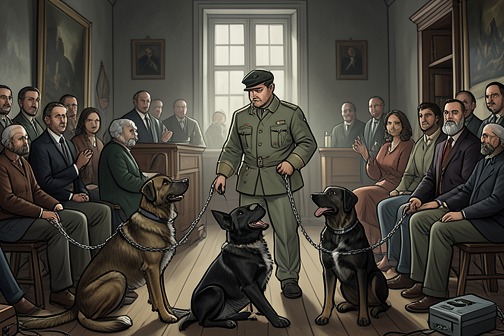
The [Police Dog-Training Performance](entity:event-recall-event-2380b822a93c) is an imagined spectacle of revenge in which the unnamed protagonist turns police officers into [Dogs](entity:creature-recall-creature-dogs-e0736038fb3e) and their families into a captive audience. A display presented as proof of the trainer’s skill becomes a sequence of coercive trials, exposing his consuming desire to dictate how others move, watch, and respond. Its significance lies not only in the reversal of authority, but in the way the performance makes the audience’s helplessness part of the show.
## An Imagined Public Demonstration
The scene begins with the protagonist preparing a public performance for an audience he selects deliberately: the animals’ parents, wives, and children. He expects familiar faces to make the Dogs less nervous, and imagines their families taking pride in the spectacle. The joke that a child might call a [Dog](entity:creature-recall-creature-256c3002440f) a son makes the reversal plain: those who ordinarily hold authority are recast as trained animals, while the protagonist assumes the role of their master.
He builds stalls against a wall so the guests cannot avoid seeing the performance and so the Dogs can see the guests. He makes sure the room is well lit, intending every movement to be visible. Rather than giving a formal introduction, he explains the wires and demonstrates them on rugs. He warns the audience that he will pull the wires if anyone disrupts the show. The arrangement makes looking part of the coercion: the families are both spectators and visible participants, confined in a space designed to keep them in view.
## From Training to Control
The imagined exhibition draws on an earlier account of training. The protagonist recalls making the Dogs hold still while badges are pinned to their noses, then forcing them to crawl over rough ground until their hands and knees are hardened. When that conditioning is undone, they must begin again. This cycle presents training not as the acquisition of a useful skill but as an imposed discipline that can be repeated whenever the trainer chooses.
The cinder-track races extend that method into public humiliation. The Dogs run after a mechanical lure under a spotlight, stopping at a box where their families are seated to perform for them. The trainer makes the race resume and prolongs it with forced rest periods and further demands. In this earlier stage of the fantasy, endurance and obedience are measured by how completely the Dogs submit to his direction. The later performance enlarges this principle: the trainer does not merely command the Dogs but scripts the conduct of the whole room.
## The [Rat](entity:creature-recall-creature-f166487de5cc) and the Reversal of the Show
The trainer presents the next test as an opportunity for the Dogs to demonstrate their courage by protecting the audience, especially the children. He insists that a rehearsed routine would not prove their instincts; the test must instead be new and unexpected. Yet the apparent test is rigged. The audience is confined to stalls, the children are positioned near the arena, and the trainer has prepared a rat’s cage so that he can stimulate the animal with an electric current. He removes the cover, observes the rat, and then opens the cage by means of the electrical apparatus, sending it toward water near the children.
The Dogs initially recoil, while the audience reacts with alarm. The trainer responds by pulling the wires and directing the Dogs toward the rat. In the ensuing struggle, the animals are injured and the rat is eventually killed. The trainer’s control is central to the episode: he uses the wires to keep the action moving and treats the fear of the Dogs and spectators as part of the performance. When the immediate contest ends, the Dogs continue toward the rat without needing further instructions, their conduct now driven by pain and anger rather than by the trainer’s prompting. The shift shows the limits of his control even within the fantasy: his interventions produce reactions that take on their own momentum.
## Compelled Performance and Audience Response
The show does not end with the rat’s death. The trainer moves the Dogs into another staged act, presenting their exhausted compliance as another performance for the audience. The scene describes their behavior as the result of training and submission rather than free choice. This continuation reinforces the logic of the spectacle: the trainer decides what the audience will see, what the Dogs must do, and when one act gives way to the next.
The audience’s response breaks through that imposed order. One spectator vomits, and others follow; the children are caught in the consequences. The trainer reacts by pulling the wires again and urging the performance onward. In this contrast, the audience’s bodily reaction is not applause or assent, though he tries to command the scene as if it were. The performance claims to demonstrate mastery, but the spectators’ inability to contain their response exposes the cost and instability of the control he imagines exercising.
## Meaning and Narrative Transition
The performance transforms the protagonist’s rage against police power into an elaborate reversal: officers become subjected bodies, their families are made to watch, and the trainer takes the position of unquestioned authority. Its staged setting, controlled lighting, stalls, wires, and audience instructions make domination a matter of arrangement as well as force. The spectacle also connects with the novel’s depiction of police abuse, including the assault on Mrs. Haagstromm, without turning the fantasy into an event that actually happened.
After the performance, the narrative moves into another imagined act of retaliation. The protagonist pictures Fred leaving the witness stand and imagines striking him before the scene shifts to the prospect of being seen by cameras. That transition places the dog show within a continuing sequence of revenge fantasies rather than presenting it as a completed public event. Its decisive disclosure is therefore about the protagonist’s imagination: he does not merely wish to expose or defeat his opponents; he constructs scenes in which he controls their bodies, their audience, and the terms on which they are watched.
Event 10
Two Police Officers Committed to a Mental Hospital
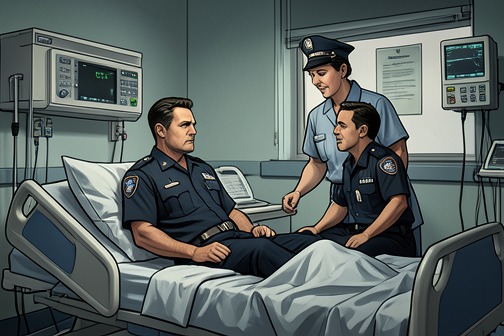
[Two Police Officers Committed to a Mental Hospital](entity:event-recall-event-b0a0b5eb774a) is the imagined judicial outcome of the [Unnamed protagonist](entity:character-recall-character-unnamed-protagonist-bb1166336c76)’s campaign against [Harry](entity:character-recall-character-harry-51d33e4b3663) and Fred. He pictures their alleged abuse of Mrs. Haagstromm being exposed in court, but the victory he constructs is not a criminal conviction: he imagines the officers judged unfit to serve and committed to a mental institution. The episode gives institutional form to his anger while revealing how thoroughly he has merged a call for accountability with a desire to punish.
## Causes and Background
The imagined proceeding grows out of the Unnamed protagonist’s wider conviction that police power is routinely misused. He presents the police as the visible agents of a police state and argues that obscure, archaic laws give officers opportunities to harass ordinary people. In his account, enforcement may depend less on a citizen’s conduct than on whether an officer chooses to use authority vindictively. This political argument supplies the framework for his personal grievance: the case against Harry and Fred becomes, in his mind, an example of a much larger pattern.
The specific obstacle he gives the case is evidentiary. He asserts that Mrs. Haagstromm is the only witness to the officers’ crime and has only brief moments of lucidity. On that basis, he says that bringing them to trial on criminal charges is legally impossible. He imagines distinguishing this limitation from the question of whether they should remain police officers: even if he cannot prove his own innocence and obtain a criminal judgment against them, he believes he can show that they are unfit to enforce the law. This distinction lets his imagined case present itself as civic duty as well as personal retaliation.
The scene also belongs to a broader narrative of the Unnamed protagonist’s conflict with legal institutions. At his own arraignment, he hears the formal language of the charges without absorbing most of its meaning, pleads not guilty, and distrusts the public defender seated beside him. Elsewhere, he imagines that the system favors people able to pay for powerful lawyers and frustrates those trying to defend themselves. These experiences and beliefs shape the fantasy’s central reversal: here, he is no longer merely the accused person watching proceedings he cannot control, but the figure who directs the case and anticipates its consequences.
## The Imagined Case
The Unnamed protagonist’s proposal is not to secure a rape conviction. Instead, he imagines asking for a psychiatric examination that will establish that Harry and Fred are emotionally unfit to serve. He predicts that the officers will not contest their dismissal, especially if they are led to believe that accepting it will spare them criminal charges. He recognizes the maneuver’s concealed premise: in his own account, there is no way to bring those charges in the first place. The proposed bargain is therefore both a tactic within his fantasy and a revealing measure of how far its promised justice depends on concealment.
He imagines court-appointed psychiatrists describing the officers as emotionally disturbed, immature, hostile, and sadistic, and concludes that the testimony will leave no effective defense. In this courtroom vision, the officers’ appointed lawyer has been instructed not to fight the dismissal because a public contest could expose embarrassing information about higher officials during an election year. The proceeding thus expands beyond the two men: the prospect of political embarrassment suggests that the abuse he attributes to them may implicate a wider institutional network. That expansion remains part of the Unnamed protagonist’s imagined account, not an independently established finding.
## Commitment and Its Consequences
In the imagined conclusion, the judge commits Harry and Fred to a state mental institution for an undetermined period. They do not protest. The Unnamed protagonist interprets their silence and visible distress as signs that punishment has begun, and pictures their confinement as the opening of a much longer retribution. He imagines monitoring their treatment and resisting any release, transforming a sentence without a specified duration into a promise of continuing control. His vision is not limited to professional accountability: it extends to prolonged confinement and the public disgrace of the officers and their families.
The imagined aftermath then appears to confirm the danger of treating this sequence as straightforward courtroom fact. The Unnamed protagonist reads a front-page account of the recently committed officers attacking hospital personnel and trying to escape. They are stopped with a tranquilizer gun, treated for injuries, and placed under restraint in a maximum-security wing. The report offers no explanation for their behavior. He takes the episode not as a reason to question his account, but as proof that the men will remain confined and that his campaign can be repeated. In this sequence, an imagined legal result acquires the apparent weight of a news report, while the protagonist’s satisfaction carries the story further from impartial justice.
## Narrative and Thematic Significance
The episode reverses the Unnamed protagonist’s position in his own trial. Earlier, he experiences charges as nearly unintelligible formal speech and regards his appointed counsel as someone who has already abandoned him. In the imagined case against Harry and Fred, he instead supplies the argument, anticipates the lawyers’ choices, and assigns meaning to the court’s decision. The contrast makes the fantasy a response to powerlessness, but does not turn it into reliable evidence about what happened outside his mind.
The commitment also exposes a conflict between the protagonist’s stated aims and the punishment he imagines. He frames the proceeding as an effort to remove unfit officers from public authority when criminal prosecution is unavailable. Yet his private vision exceeds that goal: he wants their confinement to last, their release to be obstructed, and their families to suffer social consequences. The episode therefore stages both a demand for accountability and the conversion of that demand into personal vengeance. Its decisive significance lies in that instability: the imagined court appears to correct police abuse, even as the protagonist’s expanding fantasies make justice indistinguishable from retaliation.
Event 11
Kramer's Jewelry doorway incident
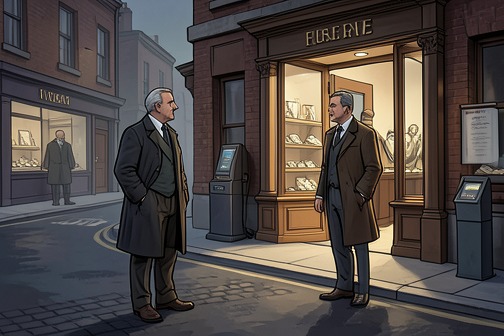
[Kramer's Jewelry doorway incident](entity:event-recall-event-kramer-s-jewelry-doorwa-a146ec626ad3) enters the narrative as disputed police testimony in the case against the [Unnamed prisoner and defendant](entity:character-recall-character-unnamed-prisoner-an-be2fb3f4f4ac). Rather than directly recounting the original encounter, the courtroom exchange reconstructs it through questions about the officers’ approach to an intersection and an officer’s sighting of a man in the doorway of [Kramers Jewelry Store](entity:location-recall-location-kramers-jewelry-stor-5388768e5189). The account matters both for its concrete details and for the way the testimony is shaped, challenged, and interpreted inside a proceeding the defendant already regards with deep suspicion.
## Procedural Setting
The testimony belongs to a larger courtroom struggle. When the charges were read, the Unnamed prisoner and defendant stood and heard words whose legal meaning mostly eluded him; he registered the sound more than the substance, then pleaded not guilty. The public defender beside him was a stranger whose name he did not know. He suspected that this unknown attorney had already abandoned him, and resolved to listen closely to the witnesses and note discrepancies the lawyer might miss. The jewelry-store testimony thus arrives under a burden of mistrust: for the defendant, the details are not merely a record of an encounter but possible material with which to contest the prosecution.
The questioning also gives the incident a sharply bounded physical frame. Asked which direction he was traveling as he approached the intersection, the officer answers north. Asked how fast he was driving, he gives an estimate of approximately twenty-five miles per hour. These particulars establish the car’s movement without, by themselves, settling exactly when the officer saw the figure or what prompted the vehicle to stop. The distinction between what the testimony specifies and what remains uncertain is central to the exchange.
## The Sighting and Its Sequence
A question places the car about one hundred feet from the intersection when the officer’s partner reportedly said he had seen someone in the doorway of Kramers Jewelry Store. The answer supplies that distance, but later questioning tests the event’s sequence more directly. Asked whether he had seen someone in the doorway and told his partner to stop the car, the officer answers that this is not exactly what happened. He says the car was already in the process of stopping for a red light as they approached the intersection; it was then that he saw a man in the doorway.
That correction is the scene’s most consequential turn. The question’s formulation links the sighting to an instruction to stop, while the officer’s account places the stop in the ordinary course of responding to a red light and the sighting during that process. The testimony therefore distinguishes between a police car stopping because its occupants have noticed a person and an officer noticing a person while the car is stopping for traffic. It does not, on the evidence presented here, establish what the man was doing beyond being in the doorway, or resolve the wider case against the defendant.
Asked how he could be sure the figure was a man, the officer points to the person’s clothing and features. A further question challenges the basis of that identification with a sarcastic reference to whether he had undressed the person. The court orders silence after the remark. The exchange shows the defense pressing the limits of the officer’s observation, but it also marks a boundary: courtroom irreverence does not itself supply an alternative identification or determine what the officer could see.
## Dispute, Interpretation, and Stakes
The prosecutor objects when the same question is put repeatedly in different forms, and the court sustains the objection, saying there is no need to repeat a question already answered. This brief intervention makes the mechanics of testimony visible. The account is not simply delivered as an uninterrupted recollection; it is produced through a sequence of questions, objections, answers, and corrections, with the court regulating how far the examination can continue. Repetition may clarify a disputed point, but the judge’s ruling limits that method of challenge.
For the Unnamed prisoner and defendant, however, the courtroom details sit inside a much broader conviction that the justice system is stacked against people without money or influence. He thinks of people jailed for petty theft and contrasts their treatment with the legal help available to the wealthy. He also imagines that a public defender might be less capable than a defendant acting for himself, while believing that procedural rules prevent him from proving it. These are his judgments and suspicions, not findings established by the doorway testimony. Their importance is that they shape how he reads every courtroom exchange: a sustained objection can feel like another barrier, while a correction in an officer’s account can appear to offer an opening.
The incident’s significance consequently remains deliberately narrower than the defendant’s sweeping accusations. The testimony fixes a direction of travel, an approximate speed, a distance from the intersection, a red-light stop, and an officer’s claimed visual basis for identifying a man. It also records a difference between the question’s proposed sequence and the officer’s version. That difference gives the defendant something to scrutinize, but the passage does not confirm that the discrepancy proves misconduct or establishes innocence. The courtroom scene holds both possibilities in view: a potentially important distinction in the chronology, and the gap between the defendant’s expectation of exposing a corrupt case and what this particular exchange actually demonstrates.
Event 12
Trial with the Defendant Acting as His Own Counsel

The [Trial with the Defendant Acting as His Own Counsel](entity:event-recall-event-e756b409d525) is a courtroom conflict in which the [Unnamed prisoner and defendant](entity:character-recall-character-unnamed-prisoner-an-be2fb3f4f4ac) tries to challenge the prosecution without a lawyer, while the court repeatedly limits how he may proceed. Its significance lies not only in the testimony about a man seen at [Kramers Jewelry Store](entity:location-recall-location-kramers-jewelry-stor-5388768e5189), but in the contrast between formal procedure and the defendant’s conviction that the legal system will not give him a fair chance to use it.
## From Preliminary Hearing to Self-Representation
The trial follows an earlier preliminary hearing that establishes why the defendant regards legal representation with suspicion. As the charges are read, he recognizes only fragments of the formal language; the rest reaches him as sound rather than meaning. He pleads not guilty, but barely registers the public defender beside him. The defender gives him paper and a pencil, asks him to write down questions instead of interrupting testimony, and then turns to his papers. The defendant interprets this distance as proof that the lawyer has already abandoned him.
At first, he tries to follow the arresting officers’ testimony and note discrepancies that might help the defense. He cannot find words for what he wants to record, however, and his attention falters as the hearing proceeds through stipulations, waived matters, and legal arguments. The defender moves to dismiss the case by citing prior decisions; the prosecutor argues against dismissal, and the judge later denies the motion. To the defendant, the hearing’s formal exchanges do not feel like meaningful advocacy. He remembers his lawyer as having let everything pass without trying to help.
The hearing also leaves him with a distorted sense of time that shapes the courtroom episodes around it. He recalls being awakened at about 5:30 and returning to his cell after 7:30, yet describes the day as fourteen hours of waiting and movement: from the bench to holding tanks, from chains to a bus, then to the courthouse and back through the same sequence. In the cell, he can replay those fourteen hours in minutes. He concludes that the hours, meals, and permanently lit nights have become indistinguishable. The court experience is thus measured both as an exhausting institutional itinerary and as a blur in which he cannot retain the details he hoped to use.
## The Trial as a Contest over Procedure
At the later trial, the court makes explicit that the defendant chose to act as his own counsel despite contrary advice and the availability of a public defender. When he continues questioning a witness about whether there were lights in the store window, the prosecutor objects that the matter has already been established by expert testimony. The prosecutor points to testimony from the [Department of Water and Power](entity:organization-recall-organization-department-of-wa-86432d6df716), the burglar-alarm company, and a report from the [United States Weather Bureau](entity:organization-recall-organization-united-states-we-9601128193e7). The court agrees that the line of questioning is unreasonable and unnecessary.
The judge then gives the defendant another opportunity to accept representation for the remainder of the trial. He declines. The court warns him that proper trial procedures must be followed and that he may be held in contempt. This exchange marks the central procedural tension: the defendant retains the choice to represent himself, but that choice does not exempt him from the court’s rules about relevant questions and repetition. From his perspective, however, the restriction confirms his belief that the system will not let him make his case on his own terms.
That tension echoes his broader account of law and policing. In a passage imagining a public denunciation of police power, he calls the state a Police State and argues that obscure laws give officers opportunities to harass citizens. He points to the many laws an ordinary person cannot know and imagines petty violations being used vindictively. These assertions are his political interpretation, not findings made by the court. They nevertheless clarify why procedural limits in the trial strike him as more than courtroom management: he reads them as part of a wider structure that can exercise authority while denying ordinary people control over how they answer it.
## Evidence and the Doorway Account
The questioning centers on what an officer saw at the doorway of Kramers Jewelry Store. The defendant asks whether the witness saw someone there and told his partner to stop the car. The officer rejects that framing: the car was already slowing for a red light as it approached the intersection, and he saw a man in the doorway then. The distinction matters to the account of how the observation occurred. The testimony does not describe a car stopped because the officers had already identified someone at the store; it places the sighting as the vehicle approached a red light.
The defendant’s questions press on how much the witness could actually know. In the exchange, the witness acknowledges that there were lights in the store window, while the prosecutor and court treat that point as already covered by other testimony. The objection does not itself establish what the defendant was trying to prove with the question, and the supplied exchange does not settle the ultimate evidentiary dispute. It shows instead how his effort to test the account meets an opposing claim that the relevant facts have already been proven, followed by the judge’s ruling that further questioning is unnecessary.
The hearing’s competing voices make the trial feel like a struggle over the boundaries of evidence as much as a search for facts. Counsel objects, the prosecutor objects to repeated questions, and the court sustains objections or orders the participants to maintain order. The defendant’s words and questions are therefore heard within a structure that can stop them, redirect them, or treat them as procedurally improper. The testimony about the doorway remains specific, but the scene also foregrounds who has the authority to decide when a question has gone far enough.
## After the [Courtroom](entity:location-recall-location-courtroom-2b80341d2488): Distrust and Consequence
The defendant’s inner response turns the legal exchange into a general indictment of unequal justice. He recalls people receiving severe consequences for small thefts, contrasts them with wealthy defendants who can afford teams of lawyers, and imagines that a lawyer such as [Stacey Lowry](entity:character-recall-character-stacey-lowry-3962c7d4dfb3) would consider representing someone like him beneath his dignity. These are the defendant’s bitter claims and examples, not independently confirmed accounts in the courtroom scene. Their force comes from the way he connects the immediate experience of being interrupted with a larger conviction that money determines who can defend themselves effectively.
He also suspects that legal rules are deployed whenever a self-represented defendant gains ground, describing the system as a succession of technicalities that makes winning impossible. The account places this suspicion beside the actual exchange: the court expressly offers him a lawyer, he refuses, and the judge warns that the rules of trial procedure still apply. Neither fact erases the other. His refusal is an exercise of choice, while his subsequent frustration shows how little confidence he has that the available choices can produce a fair hearing.
The event consequently ends, in the supplied material, without a verdict or a resolution of the underlying case. What it establishes is the defendant’s insistence on speaking for himself, the court’s insistence on procedural control, and the deepening gulf between his view of justice and the institution’s management of the trial. The courtroom does not convert his distrust into proof that every accusation is true; instead, it shows how each objection and warning becomes further evidence, in his own interpretation, that the system is aligned against him.
Event 13
Breakdown and Vomiting Episode in the Cell
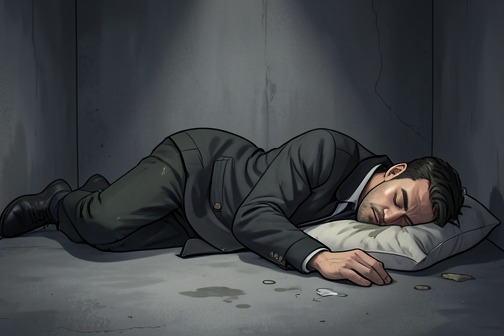
The [Breakdown and Vomiting Episode in the Cell](entity:event-recall-event-934e260561af) is a prolonged crisis in which the unnamed protagonist’s bodily distress and psychological withdrawal reinforce one another. After crying into his pillow, he loses his bearings in a nearly motionless grayness; later, an order to report for chow forces him into a public routine he can scarcely manage. Back in his cell, he vomits, struggles to recover, and attends anxiously to the space around him. The episode ends not with a clear return to ordinary functioning but with a drift toward the familiar refuge he associates with a friend.
## Collapse and grayness
At the outset, the unnamed protagonist presses his face into a pillow wet with tears. When he can go no farther, he turns his head so that his cheek rests on the damp fabric, keeping his eyes shut. The light and motion he had been experiencing give way to an almost stationary gray, described as barely definable. This shift marks a narrowing of his awareness: instead of looking outward, he remains enclosed against the pillow, with even the distinction between seeing and not seeing reduced to a dim field.
The physical stillness breaks into a small, repetitive movement. He draws his knees toward his chest, curls inward, and rocks while sobbing. The movement is laborious, and the passage emphasizes its gradual rhythm rather than any sudden release. Tears fall onto his cheek and into his mouth as the rocking continues; the gray darkens until he can sink into sleep. The scene connects exhaustion to retreat: sleep follows not a resolution of the crisis, but the shutting out of light and the exhaustion of crying.
## Chow and the demands of routine
The cell door opens to the call for chow, and the interruption is the first indication that time has moved. On waking, he initially cannot identify what he sees. Only after staring does he recognize a narrow strip of wall and the dim shape of the pillow. He then realizes that his face is almost buried in it and that the pillow is wet from his tears. Even the command to go to chow reaches him before he can readily respond to it.
Outside the cell, ordinary actions become a sequence he must consciously complete despite nausea and pain. He understands that he has to accept a tray, sit at a table for a sufficient interval, dispose of the food, return the tray, and make his way back to the cell. The passage presents these steps as obligations that have to be carried out while he feels unwell, not as a meal he is able to enjoy. His fear of collapsing on the mess hall floor competes with his wish to be back in the cell, curled up and hidden from himself.
He makes his way through the routine by keeping his body turned toward the wall. After the man across from him stands and takes up his tray, the protagonist follows the flow toward the garbage can and tray cart, then proceeds along the mess hall and corridor. His attention stays on maintaining that turned posture and avoiding a fall. The gray of his cell door becomes a point of return, but he does not simply run toward it: getting back safely depends on preserving the careful movement he has adopted.
## The vomiting episode and its aftermath
Back in the cell, his distress escalates into an episode of vomiting that he is unable to prevent. He tries to suppress it, but repeated retching and spasms overwhelm his effort. The narrative conveys the loss of control without turning the incident into an explanation or a recovery. When the episode subsides enough for him to move, he slides from the bed with his hands held close to his chest and makes his way to the commode. He watches the water and the movement on its surface, focusing on what happens there rather than on any larger interpretation of the crisis.
He next tries to wash. Supporting himself against the wall, he turns on the basin and lets water run over his hands. He attempts to bring water to his face, but it runs up his arms before he can manage it. The effort is modest and unsuccessful; the scene does not suggest that washing restores him. Instead, it records how difficult even this basic act has become and how his attention remains fixed on the immediate task in front of him.
Later, he checks the commode area with deliberate care. He examines the wall, floor, and porcelain from different angles, uses toilet paper to wipe places that seem wet, and flushes the paper away. He watches the bowl for several minutes to make sure nothing returns, checks the corner again, and then struggles to get beneath the blanket on his bed. This sequence introduces a precise, repetitive order after the earlier bodily loss of control. It offers no evidence that the checking is required by another person; it is presented as an action the protagonist undertakes himself, carefully and at length.
## Retreat and the returning refuge
The episode’s final movement takes the protagonist away from the immediate surroundings and back toward an inward, familiar state. He becomes aware of his body again, while the gray grows darker and more comforting. The narration describes this return through the image of a friend: wherever he travels in his inward experience, he comes back to the same place. His journeys have, it seems, become shorter and more frightening, and he has less desire to leave the security he finds there.
That return complicates any reading of the scene as a straightforward recovery. The protagonist does not emerge newly ready to face the world beyond the cell; even a step or two away from the refuge feels not worth the effort, and he stops trying to leave it. His diminished willingness to venture outward follows the earlier struggle to attend chow, the careful passage along the wall, and the difficulty of washing and returning to bed. The crisis therefore joins a bodily episode to an increasingly narrow sense of safety: the familiar gray is soothing precisely as the possibility of movement and engagement recedes. In the episode’s closing image, the refuge is not a solution but a place to which he feels he always returns.